You already know you don't want to send an ecard. That's why you're searching for alternatives.
You want something that feels like you actually put thought into it. Something they open and think "wow" instead of "oh, a card." Something with their name, their photos, maybe even your voice — not a stock animation of a birthday cake with canned piano music.
Here's the honest breakdown of what actually exists in 2026, ranked by how emotional the experience actually feels.
Why Ecards Stopped Working
Traditional ecards solved one problem: getting a card to someone fast without buying a stamp. They never solved the deeper problem, which is making the person opening it feel like the card was made for them.
The core issue is the starting point. Most ecards begin with a design picked from a catalog, and you add your words to it. Many sites let you add a photo or a message too, and those cards can be genuinely personal — but the card still starts with a design someone else made, not with the moments you share with the person you're sending it to.
That's what people mean when they search for ecard alternatives — they want the digital convenience without the copy-paste feeling.
The 7 Best Ecard Alternatives in 2026
1. CinematicCard — A Card Made From Your Own Memories
Best for: Anyone who wants the person opening it to remember the card
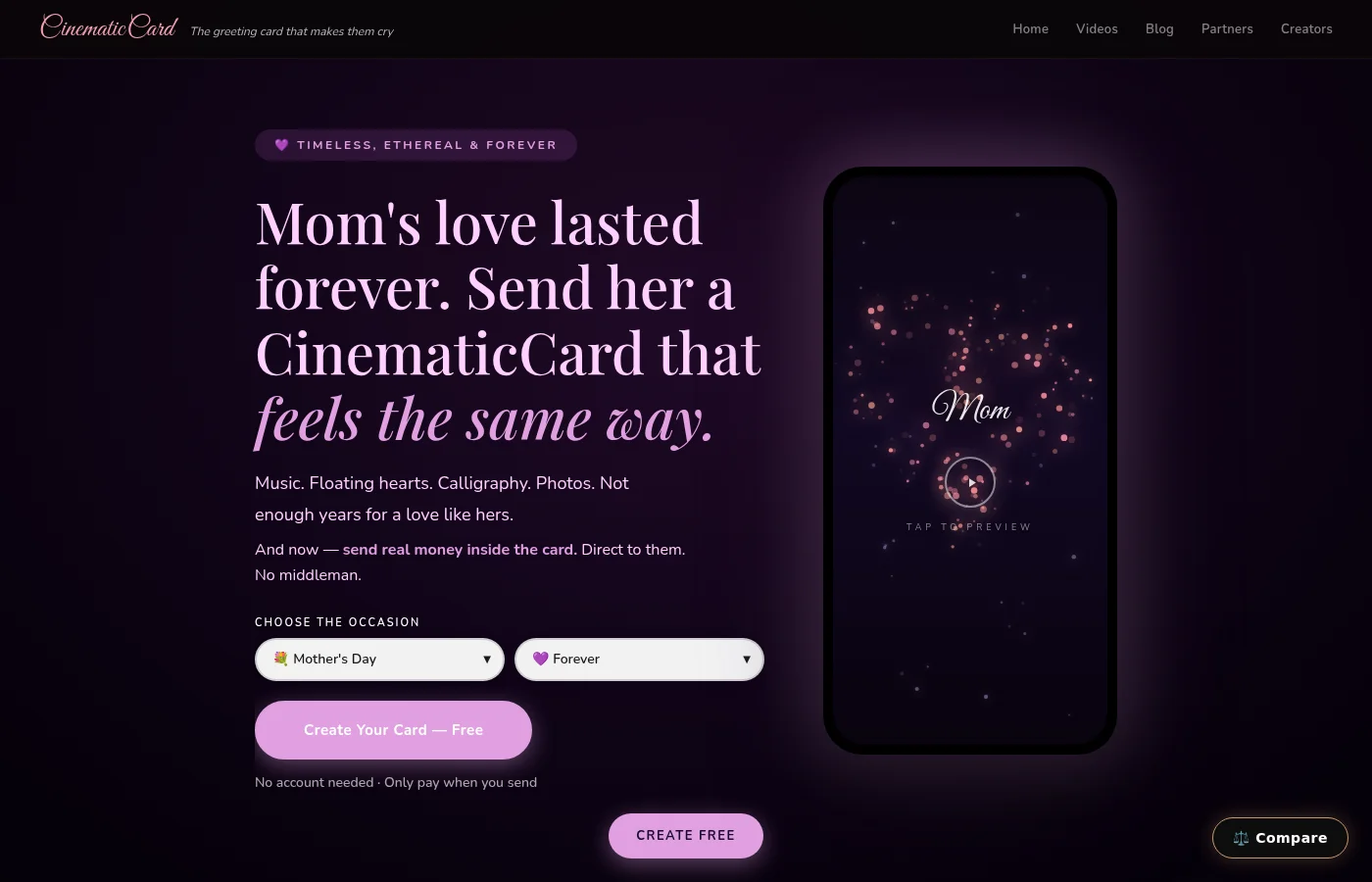
A CinematicCard is a greeting card made from your own memories. Instead of picking a design, you choose up to 20 moments from the photos on your phone, and they play as a cinematic slideshow. Their name writes itself in calligraphy. Fireworks, rose petals, or golden sparkles fill the scene. Your personal message reveals word by word, timed to music. Add a song, or record a voice message on your phone and upload it as the soundtrack.
The result is something they watch twice and then text to someone else. "You have to see what I got."
Pricing: Your first one is completely free — including sending. No credit card required. After that, from $3.99 per card. No subscription, no account needed.
What makes it different: It starts with your memories, not a catalog design — and the themes around them add cinematic particle effects, realistic lighting, and scenes designed like movie opening credits. The Father's Day theme has actual cigar smoke drifting upward through a leather study. The Valentine's card shows a fireplace with flames that flicker and illuminate the scene.
Try your first CinematicCard free →
2. Paperless Post — Beautiful Invitations That Double as Cards
Best for: Event invitations with RSVP tracking
Paperless Post is best known for invitations with RSVP, delivery and open tracking. You start with a Card or Flyer design from its collection — or upload your own design image — and send it by email, text or a shareable link, now or scheduled. Paid designs can also include a video block with sound.
The difference in approach: a Paperless Post card starts with a design, while a CinematicCard starts with your photos, your music or voice, and your message. See our Paperless Post comparison for the details.

If you're planning an event and need RSVP tracking, Paperless Post is designed around exactly that. If you want a personal greeting card built from the moments you share with someone, a memory-first card is the closer fit.
Pricing: Free designs for up to 50 people; paid designs cost 2–8 Coins per person, with an annual Pro subscription available.
3. Moonpig — Physical Cards Delivered
Best for: People who still want paper in hand
Moonpig starts with a printed card design you personalize, with optional photo upload, and mails it by post (in the US, about 1–5 working days depending on the service). It can also print a QR code inside the card that links to a video or audio message for up to 6 months, and it offers eCards by email.
The tradeoff: if you want paper in hand, it's a good route — you just plan around delivery time. A CinematicCard can be shared by link the moment it's made, or scheduled for a date you choose.
Pricing: Priced per card plus delivery; eCards are $0.99. Registration is required.
4. JibJab — Comedy Face-Swap Videos
Best for: Getting a laugh, not making someone cry (happy tears)
JibJab uses your photos to cut out faces and place them into its animated Ecard and video templates. It's genuinely funny for the right occasion — office parties, roast-style birthday cards, people with a good sense of humor about themselves.
The difference: with JibJab, the animation is the star and your photos supply the faces. With a CinematicCard, your photos are the story — up to 20 of them, played as a cinematic slideshow with your music and message.
Pricing: JibJab's Help Center lists Premium at $36/year or $24 per 6 months (web/iOS), or $6.99/month in the app, and it auto-renews. Limited free Ecards and GIFs are available.
5. Canva — Design Your Own Card from Scratch
Best for: Design-minded senders who want full creative control
Canva is a design platform, and it includes card templates. If you want to lay out every element yourself, you can make something genuinely custom.
The practical difference: you're designing the card, so the time it takes depends on how much you want to design. With a CinematicCard, the hardest part is choosing the memories — once you have, creating the card takes less than a minute.
Pricing: Check Canva's site for its current plans.
6. American Greetings — The Classic Membership Ecard
Best for: People who send a lot of ecards through the year
American Greetings offers ecards with motion and sound, SmashUps (including Selfie SmashUps), and Creatacard designs where you can add up to six photos (or one video) plus music or a custom song. Cards go out by email, text (US/Canada), copied link or Facebook, and members can schedule them.
A membership makes sense if you send many cards a year. The starting point is an American Greetings design; a CinematicCard starts with your own memories. Our American Greetings comparison lays it out side by side.

Pricing: $7.99/month, $35.99/year or $49.99 for 2 years, with a 7-day free trial; a limited selection of ecards is free.
7. Physical Cards with a QR Code
Best for: People who want to combine old and new
Buy a nice physical card, write something personal inside, then add a QR code that links to a CinematicCard, video, or photo album. The person gets a tangible card and a digital experience.
This requires more effort but gives you both the physical feel and the cinematic impact. Some people find the hybrid approach more meaningful than either option alone.
Cost: Price of the card + whatever digital experience you link to.
What to Look For in an Ecard Alternative
Not all ecard alternatives are built for the same job. Here's what to look for when the goal is a card they'll remember:
Where the card starts: Does it start with a design you pick, or with your own memories? Both can be personal, but a card built from the photos you share with someone feels made just for them.
Personalization beyond text: Typing "Happy Birthday Sarah" is table stakes. Can you add years of photos? Can you include your own voice? Can they hear something that only you could have sent?
No subscription required: You shouldn't pay monthly for greeting cards. Most people send a handful of meaningful cards per year. Pay per card makes more sense than paying every month and forgetting about it.
Mobile-first delivery: They're most likely going to open this on their phone. The experience should be designed for that, not an afterthought.
Why the "First One Free" Offer Changes the Math
Many card services ask you to pay (or subscribe) before you know if you'll actually like what you're getting. CinematicCard flips this: your first card is completely free, including sending it, and previewing is always free.
Choose your photos. Pick the theme. Write your message. Preview the whole experience. Then lock it in with your email at checkout — and your first send costs you nothing.
No credit card required upfront. No subscription that starts quietly billing you next month.
This is important because the experience of receiving a CinematicCard is genuinely different from receiving an ecard. You need to see it to understand why people save the link and come back to watch it again.
The Bottom Line
If you want a design-led card, an invitation with RSVPs, or paper in the mail, the options above each do that job well.
If you want a card made from your own memories — one they watch twice, screenshot, and text their friends — you want CinematicCard.
Your first one is free. No credit card, no subscription, no risk. The hardest part is choosing the memories; once you have, creating the card takes less than a minute.