Open most "animated" greeting cards and you'll find one of three things: a cartoon character that waves in a loop, confetti falling in a perfect straight line, or text that slides in from the left like a 2003 PowerPoint presentation.
That's not animation. That's a GIF with a price tag.
Real animation — the kind that makes someone pause, watch again, and send a screenshot to their friend — is a completely different thing. In 2026, one platform has figured out what that actually looks like.
What Most "Animated" Greeting Cards Actually Are
Let's be honest about the ecard industry for a second.
When Hallmark, American Greetings, and most ecard platforms advertise "animated cards," what they mean is this: a static illustration with a simple motion loop applied to one element. A flower that blooms and resets. A candle flame that flickers on a 2-second loop. A heart that pulses three times and stops.
This isn't animation in any meaningful sense. It's decoration. It communicates roughly the same thing as a paper card — "here is a pleasant image with some text" — but with the added indignity of feeling cheap because you can see the seams where the loop resets.
The other category is face-swap comedy videos (JibJab and similar) — your face on a dancing character. Funny once, occasionally. Not the right vibe for the 60th birthday, the anniversary, or the moment you want someone to genuinely feel loved.
What Real Animation Looks Like in a Greeting Card
Real animation in a greeting card means a few specific things.
It has layers. Real animation isn't one element moving against a static background. It's the entire scene alive at once — foreground elements moving at different speeds than background elements, lighting that shifts and responds to what's in the scene, particle effects that behave like they're obeying actual physics.
It has timing. The best cinematic greeting cards build. Something happens first — a name writes itself in calligraphy, stroke by stroke, as music starts. Then the background comes alive. Then your photos appear. Then your message reveals word by word. The experience has a beginning, middle, and end. It tells a story.
It's specific. Generic animation is confetti falling. Specific animation is cigar smoke drifting upward through a leather study while "DAD" appears in the smoke — because that was designed specifically for Father's Day, for the way people think about their fathers, not just as a generic "celebration" background.
CinematicCard: Where Greeting Cards Became Films
CinematicCard builds every theme from scratch around the specific emotion of the occasion.

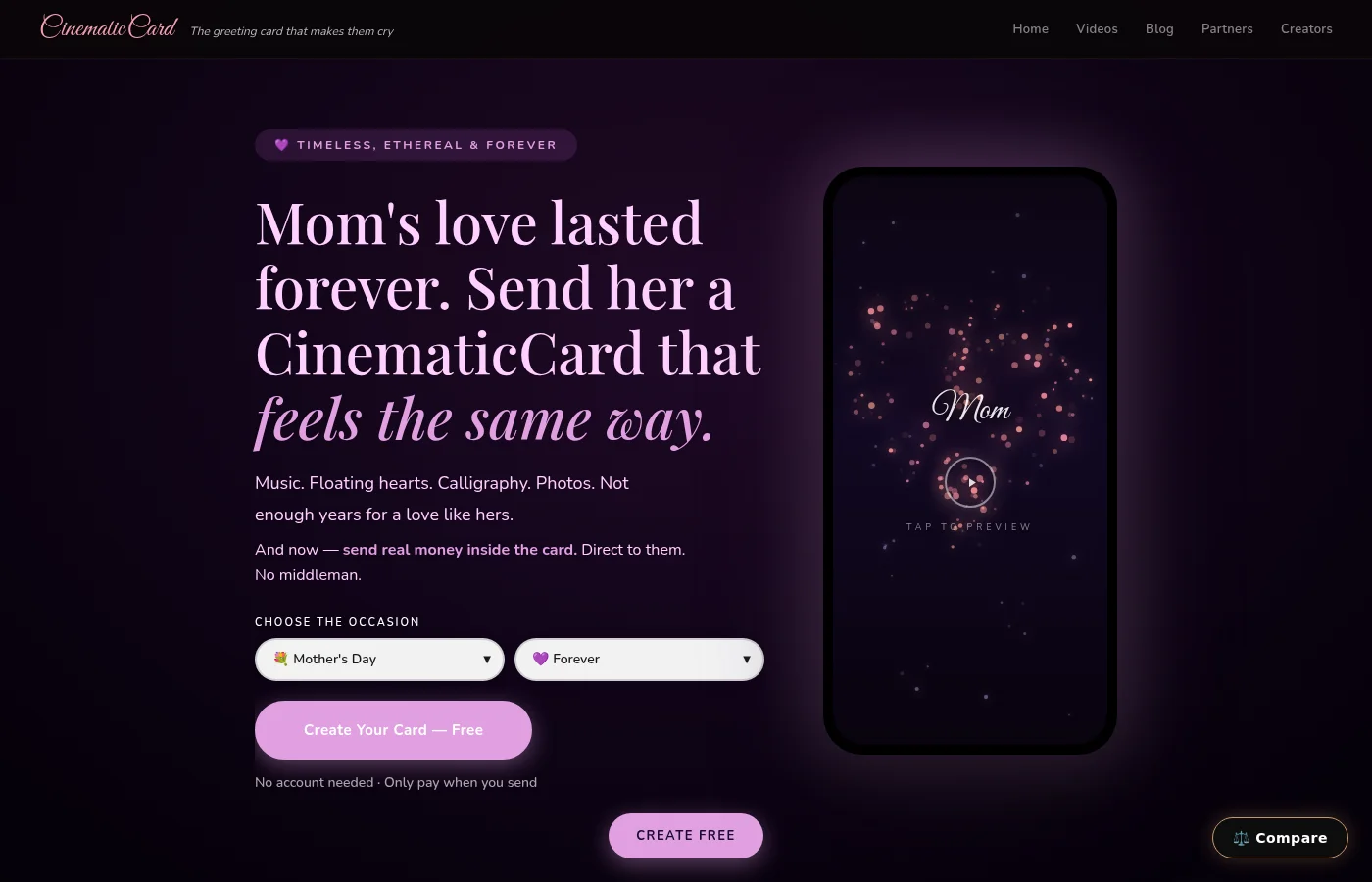
The Mother's Day garden theme doesn't just show flowers — it shows a butterfly landing on a bubble bath while petals drift down like a blessing, with the word "MOM" writing itself in elegant script as the lighting shifts to golden hour.
The Valentine's for him theme is a realistic fireplace study: two wine glasses with golden bubbles actually rising through the liquid, flames that flicker with light that illuminates the whole scene, 25 gold sparkles that catch the firelight.
The birthday themes have countdowns that build tension before fireworks explode outward from the center — actual particle effects with realistic trajectories, not a looping GIF of confetti.
The Father's Day theme is the one that gets people: cigar smoke drifts upward through an entire frame, wisping into "DAD" written in smoke overlay. It's moody, cinematic, and unlike anything else in the digital greeting card space.
None of this is a loop. It's a 60-second film built around the person you're sending it to.
The Personalization Layer That Changes Everything
Here's where CinematicCard separates itself even from other "cinematic" options: every card is actually built around the recipient.
Their name writes itself in calligraphy. Not a generic "Happy Birthday" — the person's actual name, appearing stroke by stroke in flowing script as the scene builds behind it.
Your photos play as part of the film. Add up to 20 photos that appear in cinematic frames — Ken Burns effects, parallax movement, vintage paper textures, depending on the theme. Their 30-year friendship history plays out while the fireworks build.
Your voice is the soundtrack. Most "animated" cards give you a choice of five generic music tracks. CinematicCard lets you upload an MP3, MP4, or voice recording. Your mom hears you saying "Happy Mother's Day" while the butterfly garden plays. There is nothing else like this in the greeting card space.
Your message reveals cinematically. Your words appear word by word, timed to the music, in typography that matches the theme. Not a text box slapped over an animation. Part of the film.
Comparing Animated Greeting Card Options
Hallmark ecards: Static images with basic motion loops. Their "animation" is the 2009 definition of the word. $4.99/month subscription.
American Greetings: Similar to Hallmark. Large library, consistent mediocrity. $4.99/month.
JibJab: Video-first, face-swap comedy. Genuinely different from the above, but limited to their pre-made scenarios. $3.99/month.
Canva: Full design tool, not a greeting card platform. Can make beautiful things but takes real time and skill.

CinematicCard: Cinematic film experiences with real particle animation, personalized calligraphy, photo slideshows, custom audio. First card is completely free. After that, from $3.99. No subscription.
The First One Is Free
Here's the thing about claiming your greeting card has "real animation" — you need to see it to believe it.
So CinematicCard makes the first one completely free. Create the card, pick your theme, upload photos, write your message, preview the entire 60-second experience. Then lock it in and send it — at no charge for your first card. No credit card required upfront.
This matters because the person who receives a CinematicCard has a different reaction than the person who receives an ecard. They watch it again. They screenshot it. They show it to someone else in the room. That response is what you're paying for — and for your first card, you're not paying at all.
What Makes a Card Worth Watching Twice
The standard nobody talks about but everyone understands: would you watch this again by choice?
Not because you missed something. Not because you had to. Because it was worth the 60 seconds a second time.
Most animated greeting cards don't pass this test. They're efficient, not captivating. They communicate "I thought of you" without actually creating a moment.
A birthday card with a real cinematic countdown, fireworks that actually burst, your photos playing to music you chose, and your name written in calligraphy — that card gets watched again. It gets screenshotted. It gets saved to a camera roll and looked at months later.
That's the difference between animated and cinematic.
Try It Free
Your first CinematicCard is completely free — create it, preview it, and send it without entering a credit card.
Pick a theme from 30+ cinematic scenes designed for every occasion. Add photos if you want. Choose music or upload your voice. Write your message. Watch the preview.
Then decide if this is the kind of card you want to send.
Start your free animated card at CinematicCard.com →
No subscription. No account required. Just a card that actually feels like something.