How a Birthday Card Stopped My Mom in Her Tracks for 20 Minutes
I built my first cinematic greeting card for my mom's 78th birthday. She watched it four times in a row and cried each time. Then she called me sobbing -- not sad moved, but that overwhelming happy moved when something hits you right in the heart.
I thought I was just making a nice birthday card. I didn't know I was about to watch my tough-as-nails mother turn into an emotional wreck over fireworks and photos on a screen.
The Birthday Card Made My Mom Cry (And I Recorded It)
Here's what happened: Instead of buying another generic "Happy Birthday Mom" card from the grocery store, I spent a weekend building something different. A birthday card that wasn't just a card -- it was a short film.
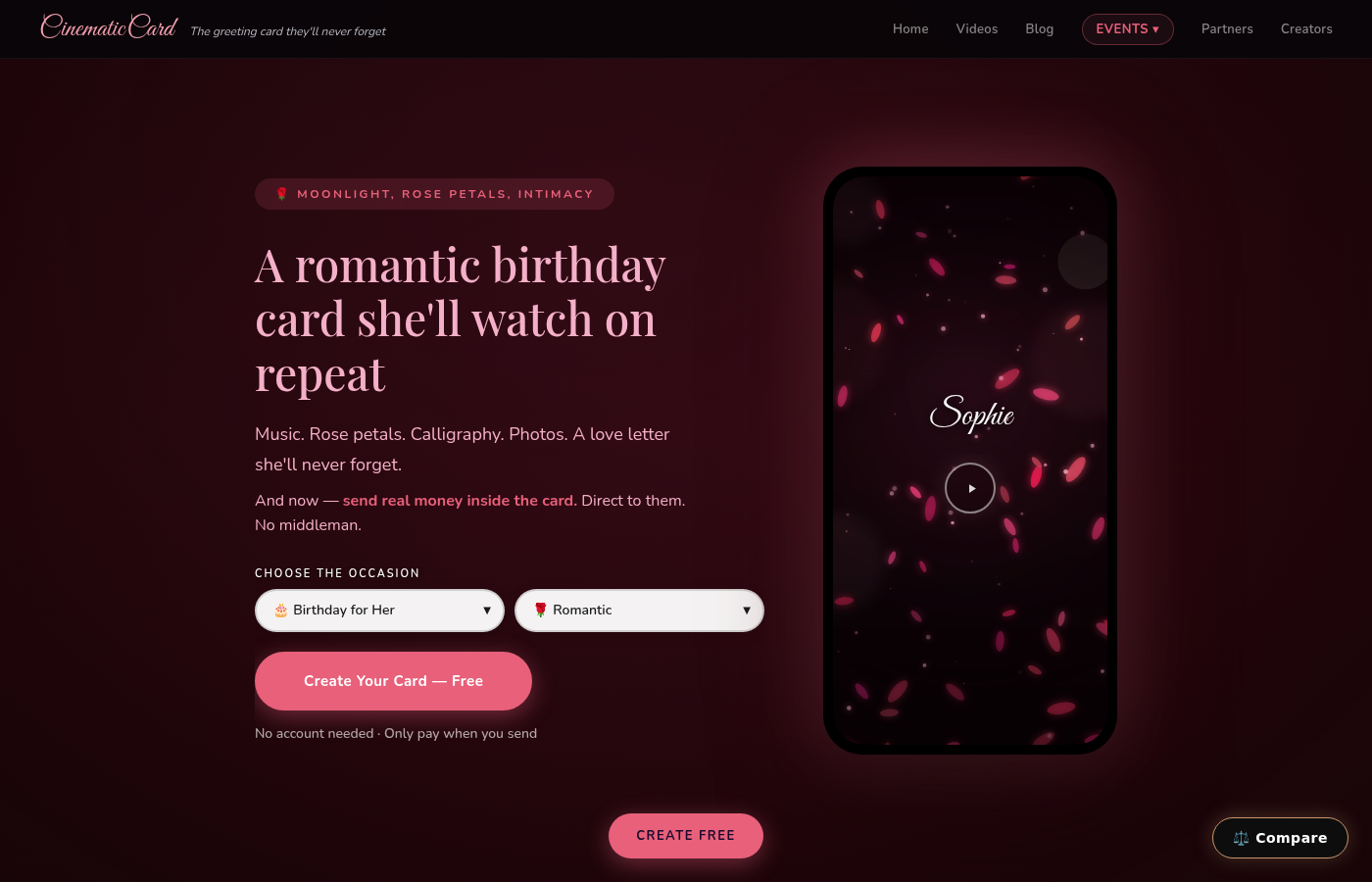
When Mom opened the link on her phone, gentle piano music started playing immediately. Her name wrote across the screen in beautiful calligraphy, stroke by stroke. Then the fireworks started -- not cartoon explosions, but realistic bursts of gold and blue against a dark navy background, with floating bokeh orbs that popped like champagne bubbles.
But here's where it got real: A slideshow of our family photos played in a cinematic frame. Her wedding day. Me as a gap-toothed kid. Christmas mornings. Her holding her grandkids. Twenty years of memories flowing past those animated fireworks.
The card ended with "I love you, Mom" writing across the screen in that same elegant calligraphy.
She called me fifteen minutes later, voice shaky: "Honey, what did you DO to me?"
Why Static Cards Don't Hit the Same Way
Look, I've sent plenty of traditional greeting cards. The nice ones from Hallmark with the thoughtful messages. Even digital cards from other services -- you know, the ones where you pick a background, add text, maybe there's a music button to click.
They're fine. They get the job done.
But they don't make anyone speechless for twenty minutes.
The difference is story. Every other digital birthday card is basically a pretty image with words on it. What I built for Mom was a cinematic experience -- music, animation, photos, and calligraphy all working together to create something that felt like a movie made just for her.
When you see your name writing itself across the screen while your favorite memories play and fireworks explode around them... it's not just a card anymore. It's a moment.

The Animation Details That Actually Matter
The birthday cards I build now aren't just "animated" -- they're choreographed. Take the "Birthday For Him" theme that gave my mom a moment she never forgot. The fireworks aren't random. They build to a grand finale, with gold bokeh orbs that actually pop in sequence. The timing matches the music. The calligraphy appears at exactly the right moment.
Or the "Birthday For Her" version: confetti bursts in pink and gold, with bokeh circles that feel like champagne bubbles floating up from the bottom of the screen. Every particle effect is timed to the emotional beats of the music.
It's the difference between watching a home video and watching a Pixar film. Both have moving pictures, but only one was designed to make you feel something specific.
Is a Digital Birthday Card Tacky?
I get this question a lot, especially from people who think "real" cards have to be physical. Here's my answer: What's tackier -- a mass-produced piece of cardstock with generic text, or a personalized short film with your loved one's favorite photos and their name in beautiful calligraphy?
Mom kept the link to her birthday card in her phone. She's showed it to her friends at least a dozen times. She's watched it again on every bad day since I sent it.
Try doing that with a paper card.
The emotional birthday card isn't about the format -- it's about the thought, the personalization, the feeling it creates. A piece of paper can't hold twenty photos, play music, and animate your name across the screen. A digital birthday card can.
What Friends Started Asking For
Word got out about Mom's birthday card. Friends saw her showing it off and started asking: "Can you make one for MY mom's birthday?"
Then it was anniversary cards. Then Father's Day cards with cigar smoke rising through the frame (the smoke secretly spells "DAD" as it drifts upward -- took me three days to get that animation right). Then mother's day cards with butterfly animations and falling flower petals.
Each one made someone speechless. Each one got watched multiple times. Each one became a keepsake in someone's phone instead of something that sits on a shelf for a week and gets thrown away.
That's when I realized this wasn't just about birthday cards. This was about turning greeting cards into experiences people actually treasure.
The Voice Recording That Changed Everything
The feature that really breaks people is the voice upload. In the Signature tier, you can record your own voice as the card's soundtrack instead of using the background music.
Imagine your mom opening her birthday card and hearing YOUR voice saying "Happy Birthday, Mom. I love you so much" while her name writes across the screen and fireworks explode around photos of your family.
No other digital card service offers this. Everyone else gives you stock music and calls it personalized. We let you literally put your voice inside the card.

I used this for Mom's 79th birthday (yes, I made her another one). Hearing my voice while watching the animations and photos... she didn't just speechless this time. She called my sister to play it for her while she was still sobbing.
Creating Cards That Actually Get Treasured
Here's what I learned from watching people react to these cards: Nobody treasures generic. People treasure specific.
The birthday card that gave my mom a moment she never forgot wasn't special because of the technology. It was special because every detail was chosen for her. The photos were HER memories. The timing was designed to build emotion. The fireworks weren't random -- they were timed to crescendo at exactly the moment her favorite photo appeared.
When you create a card at CinematicCard, you're not filling in a template. You're building a short film. You choose which photos tell the story. You decide what the calligraphy says. You can even upload your own voice as the soundtrack.
The result is something that feels handmade, even though it's digital. Something worth watching four times in a row. Something worth keeping in your phone forever.
The Simple Truth About Memorable Cards
Static cards get looked at once and forgotten. Cinematic cards get watched repeatedly and shared.
Mom's original birthday card has been opened 47 times according to my analytics. Forty-seven times. She's watched her own birthday card forty-seven times in two years.
When was the last time someone looked at a paper greeting card 47 times?
That's the difference between sending a card and creating a moment. Between giving a gift and making a memory. Between something that gets thrown away and something that gets treasured.
Try Making Someone Cry (Happy Tears)
Building a cinematic birthday card is free at CinematicCard. You can create the whole thing, preview it, test it, perfect it -- all without paying a cent. You only pay when you're ready to send it.
Start with the Classic version for $3.99 if you want the full cinematic experience with music and effects. Upgrade to Premium for $6.99 to add up to 20 photos. Or go Signature for $9.99 and upload your own voice recording -- trust me, that's the one that really makes people speechless.
My mom turns 80 next month. I'm already working on her card. This year, I'm including a recording of her own mother's voice that I found on an old cassette tape.
If that doesn't leave her speechless, nothing will.
Create your own at CinematicCard.com -- someone you love is about to have a very good day.
The Part Competitors Can't Copy: The Creation Experience
Here's something the comparison charts don't show you: what it feels like to make the card. On CinematicCard, you go to the site, pick a theme, and the entire mood shifts — music plays, particles drift across the screen, and you're suddenly in the world your recipient will experience. Type your message, upload photos if you want, and hit preview. The whole thing takes about two minutes. No account. No app download. No subscription. You see exactly what they'll see — the fireworks, the calligraphy writing their name, the music swelling. And when you finalize? A wax seal animation stamps your card shut. When you hit send, the envelope closes and launches off the screen like a letter from a movie. Most competitors give you a "processing..." spinner. CinematicCard makes even the send button an experience. You can preview the entire thing free before you spend a single dollar.
Send Cash Inside Your Card
Include a real cash gift via Venmo, PayPal, or CashApp. Cinematic envelope reveal. One tap to claim.
How it works →Bulk Send: From $3.99/Card
Volume pricing: 25 @ $7.99, 100 @ $5.99, 500+ @ $3.99/card. Upload a CSV — each person gets their own personalized card.
See bulk pricing →Upload Your Own Audio
Upload any MP3 or MP4 — your voice, your song, a personal message. They hear YOU, not stock music.
Learn more →20 Photos. No Competitor Comes Close.
Upload up to 20 photos and we turn them into a cinematic slideshow. Most competitors limit you to 1-3.
See it in action →Ready to make someone feel something real?
create your card for free. Only pay when you send it.
Create Your Card Free