CinematicCard vs Paperless Post — Which Digital Card Is Better in 2026?
If you're choosing between CinematicCard and Paperless Post, you're already ahead of the game — both are a lot more thoughtful than a last-minute text. But they're built for different moments, and the differences are worth knowing.
Here's how they compare. (For a quick feature-by-feature view, see our side-by-side Paperless Post comparison.)
[VIDEO:7FWQd8r6ASE]
What Is Paperless Post?
Paperless Post is best known for invitations — dinner parties, baby showers, weddings and more — with RSVPs, delivery and open tracking. It also offers Cards and Flyers.
You start with a Card or Flyer design from its collection, or upload your own design image, and you can add an optional video block with sound (a paid feature). Paperless Post sends by email, text (US/Canada) or a shareable link, and you can schedule delivery. If you need to invite a group and track RSVPs, Paperless Post is designed around that.
What Is CinematicCard?
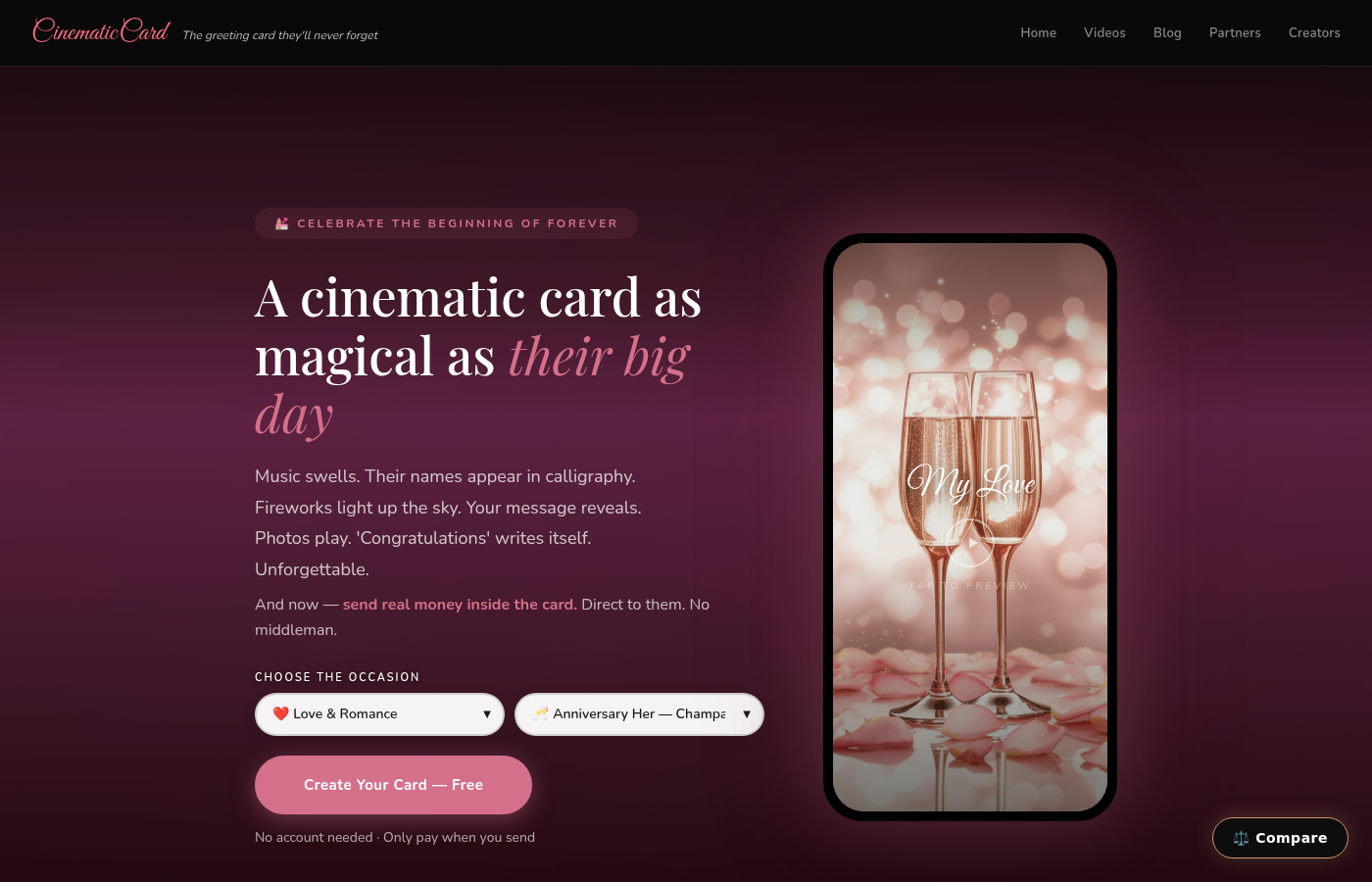
CinematicCard takes a different starting point: a CinematicCard is a greeting card made from your own memories. You choose up to 20 moments from the photos on your phone, add your words, and add your music or your own voice (an uploaded recording). When they open it, the music begins, their name writes itself in calligraphy across the screen, your message appears, and your photos play as a cinematic slideshow. You can even attach a cash gift via Venmo, PayPal, or Cash App.

You choose the theme, the music, the message and the photos. The hardest part is choosing the memories; once you have, creating the card takes less than a minute.
How CinematicCard Compares
Feature-by-feature, alongside other greeting card platforms
| Feature | CinematicCard Free, then $3.99 |
Hallmark | Paperless Post | American Greetings | Moonpig |
|---|---|---|---|---|---|
| Starting price What it costs |
Free, then $3.99 | 1 free eCard/month with Crown Rewards; Hallmark+ $8.99/mo or $79.99/yr plus tax | Free designs for up to 50 people; paid designs 2–8 Coins per person | Membership $7.99/mo, $35.99/yr or $49.99/2 yrs; limited free ecards | Priced per card plus delivery; eCards £/$/€0.99 |
| Subscription Recurring plan |
Not needed | Optional (Hallmark+) | Optional (annual Pro) | Membership, 7-day free trial | Optional (Moonpig Plus, UK) |
| Account To send a card |
Not needed | Join Crown Rewards or sign in to send eCards | — | — | Registration required |
| Starting point Where the card begins |
Your own memories | A Hallmark design you personalize | A Card or Flyer design, or one you upload | An ecard, SmashUp or Creatacard design | A printed card design you personalize |
| Sound What plays on the card |
Theme soundtrack or your own audio upload | — | Optional video block with sound (paid) | Ecards with motion and sound; music or a custom song in Creatacard | Free video or audio message via a QR code inside the card |
| Photos Your photos in the card |
Up to 20, as a cinematic slideshow | Upload photos to an eCard design; printed cards with 1, 2–4 or 5+ photos | Upload your own design image; video section (paid) | Up to six photos (or one video) in a Creatacard | Photo upload, including 5+ photo cards |
| Cash gift inside card Venmo, PayPal, Cash App |
Yes (Signature) | Hallmark + Venmo greeting cards program | — | — | — |
| Delivery How it reaches them |
Link or email · now or scheduled | eCards by email; printed cards mailed to US addresses | Email, text (US/Canada) or link; scheduling | Email, text (US/Canada), link or Facebook; scheduling for members | By mail (US about 1–5 working days); eCards by email |
| Event invitations + RSVPs Invite guests, track replies |
Separate event invitations with RSVPs | — | Best known for invitations with RSVP and tracking | — | — |
Where Paperless Post Wins
Credit where it's due. Paperless Post is a great fit if:
You're sending event invitations. Paperless Post is best known for invitations with RSVPs, delivery and open tracking. If you need 50 people to RSVP to a dinner party, that's what it's designed around.
You want to start from a design collection. You can choose a Card or Flyer design from its collection, or upload a design of your own.
You're sending to a group on a budget. Paperless Post offers free designs for up to 50 people; paid designs cost 2–8 Coins per person, and there's an annual Pro subscription.
Where CinematicCard Wins
For personal greeting cards — the kind where you want someone to feel something when they open it — CinematicCard is built for exactly that.
The experience. A design-first card starts with artwork you choose. A CinematicCard starts with your memories and plays them back as a cinematic card with music and your message. They don't just read your card — they experience it.

Photos. If you want to include photos of shared memories — a birthday trip, an anniversary dinner, your kid's first steps — CinematicCard lets you add up to 20 from your phone and plays them as a cinematic slideshow.
Voice and music. Music plays when they open a CinematicCard — a soundtrack for your theme, or your own upload. Record a voice message on your phone and upload it (WAV, MP3 or MP4), and it plays as the card audio.
Cash gifts. The Signature card has built-in cash gift support with a reveal animation. They see the amount, the platform, and a link to collect. No separate Venmo text needed.
No account, no subscription. Your first CinematicCard is free — the complete card, sent — and previewing is always free. No account creation, no app download, no subscription.
Simple pricing. After your first free card, CinematicCard is $3.99 for Classic, $6.99 for Premium (photos plus your own audio), and $9.99 for Signature (cash gift, everything included). Scheduled delivery is +$1.00. Need birthday cards or anniversary cards for the whole family? Bulk pricing drops to $3.99/card at 500.
The Verdict
These platforms serve different purposes. Paperless Post is best known for invitations with RSVP tracking, and also offers Cards and Flyers. CinematicCard is built for personal greeting cards made from your memories, and also offers separate event invitations with RSVPs.
If you need to invite a group and track RSVPs, Paperless Post is designed around that. If you want to send someone a greeting card made from the moments you share — with music, photos, your voice, and maybe some cash — CinematicCard is the natural choice.
The best way to see the difference is to try it yourself. Previewing is always free, and your first CinematicCard is free to send. Once you've chosen your memories, it takes less than a minute to see what a cinematic greeting card actually looks like.