The Difference Between an E-Card and a Cinematic Card
Say your aunt sends you a birthday e-card. You click the link and see a cheerful birthday design she picked out, with a short note from her. It's sweet, you send a "thank you" text, and the moment passes.
Now imagine this instead: You click a link and immediately hear smooth jazz. A leather armchair fades into view. A whiskey glass sits nearby, ice cube slowly spinning like someone just stirred it. Wispy smoke rises from a cigar, and if you watch closely, that smoke occasionally forms the word "Dad" before dissolving into the air. Your name writes itself across the screen in elegant calligraphy, stroke by stroke. A personal message appears, followed by your favorite photos together, the ones that bring the memories right back. The whole thing ends with "Happy Father's Day" writing itself across the screen in handwriting that looks human, not digital.
That's the difference between an e-card and a cinematic card. One is a digital version of something that already exists. The other is an entirely new medium.
What Makes an E-Card an E-Card?
Traditional e-cards are greeting cards that live on the internet. Most start with a design picked from the site's catalog, plus your message. On Hallmark.com, for example, you personalize a Hallmark design with photos and a message; American Greetings offers ecards with motion and sound, and Creatacard designs where you can add up to six photos and choose music.
The starting point is the site's artwork, and your words are what make it yours.
Most e-cards follow the same basic formula that physical greeting cards have used for decades: design + message + sentiment. The digital format makes delivery fast and easy.
That's not a bad thing -- it's familiar, it's convenient, and a thoughtful message can make it personal. A cinematic card simply starts somewhere else.
What Makes a Cinematic Card Different?
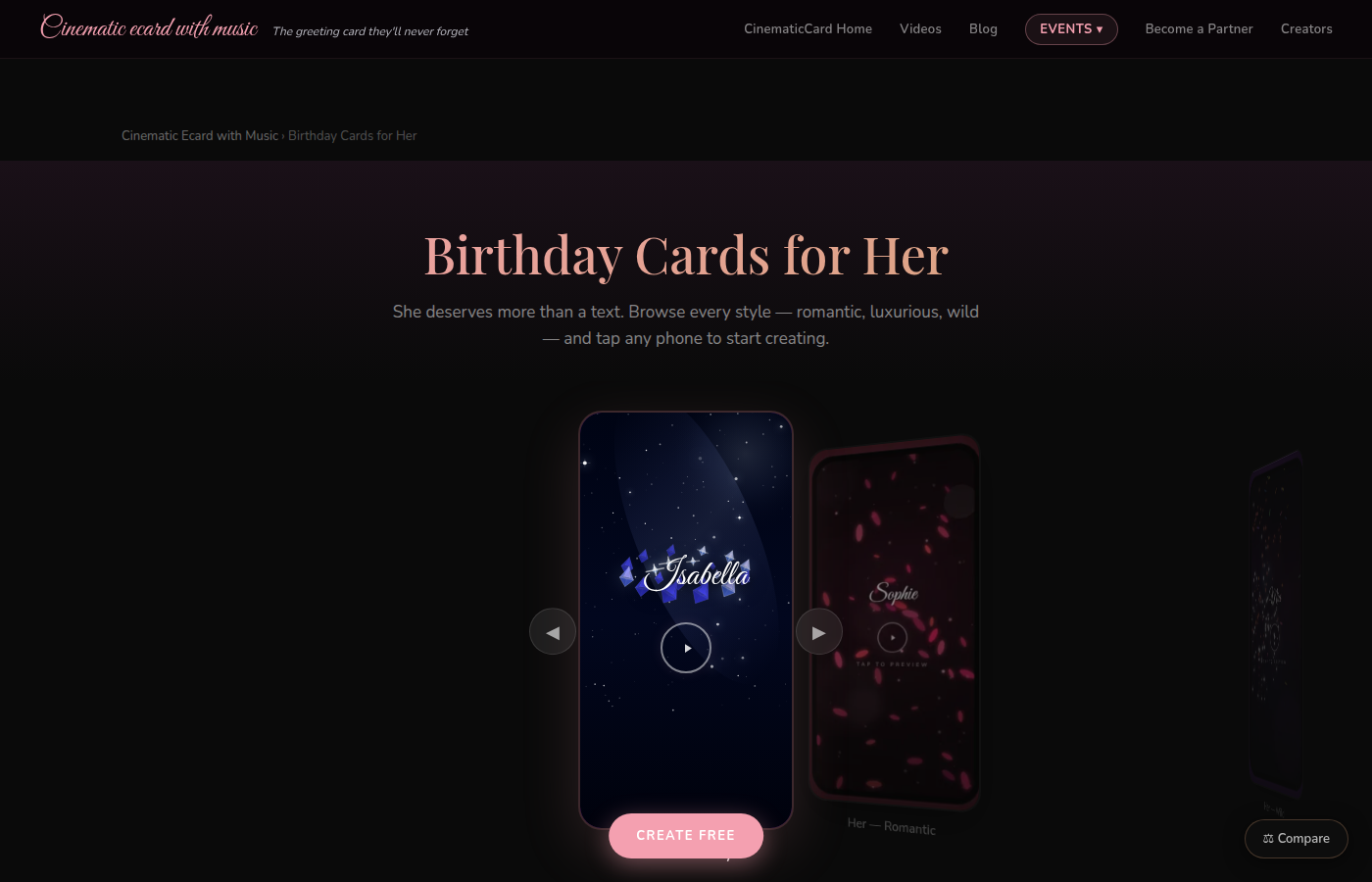
A cinematic card tells a story from the moment you open it. Instead of showing you everything at once, it unfolds over time like a short film.
Take our birthday cards for kids. The animation doesn't just show a birthday cake -- it creates an entire scene. An animated countdown appears: 3... 2... 1... YAY! Cartoon animals pop up from behind the numbers. A bunny waddles in holding a birthday cake. Balloons float up from the bottom of the screen. There's a beginning, middle, and end. There's anticipation, payoff, and surprise.

Or consider the Missing You card. Instead of a single image of two people hugging, you watch a story: Two silhouettes enter from opposite sides of the screen. They embrace in the center. Hundreds of hearts erupt, filling the screen. Then they reluctantly pull apart, arms still reaching toward each other. A red thread of fate connects their hearts, stretching as they move away but never breaking. Finally, text writes itself in the gap between them: "Until I can hold you again..."
That's not just a greeting card. That's an experience that matches the emotional weight of missing someone you love.
Why Animation Matters for Emotional Connection
Here's something interesting about how our brains work: static images trigger recognition, but movement triggers emotion.
When you see a photo of a fireplace, you think "fireplace." When you see flames that actually flicker, embers that actually glow, and shadows that dance on the wall, you feel warmth. You feel cozy. You feel like you're there.
That's why our Father's Day card doesn't just show a cigar -- it shows smoke rising from that cigar, curling and twisting, occasionally forming the word "Dad" before dissolving back into wisps. Your brain doesn't just process the image; it gets lost in watching the smoke move.
The same principle applies to every element. When champagne glasses clink together in our anniversary cards, you don't just see the glasses -- you see the moment of impact, the champagne droplets catching rose gold light, the number of years together floating up inside a bubble. Each detail builds emotional momentum.
Is a Digital Greeting Card Tacky?
This depends entirely on execution, not format.
A hastily chosen e-card with a generic message feels impersonal because it is impersonal. You spent thirty seconds picking it, they spend ten seconds looking at it, and nobody remembers it afterward.
But when someone receives a card where their name writes itself in calligraphy, where every animation element tells part of a bigger story, where the music matches the mood, where there's a slideshow of photos of the moments you share -- that doesn't feel generic. That feels like it was made just for them.
The "tackiness" factor usually comes from obvious shortcuts: a rushed pick, a message that could be to anyone. When every detail feels intentional and custom, the medium becomes irrelevant. The thought and care come through.

The Ecard Comparison: Designs vs. Memories
Traditional e-cards optimize for convenience. Pick a design, add a message, hit send. (For a feature-by-feature look, see our side-by-side e-card comparison.)
Cinematic cards start with your memories. The hardest part is choosing the photos that matter to your relationship; once you have, creating the card takes less than a minute. The result is something worth watching multiple times.
When Sid built the first cinematic card for his mom's 78th birthday, she didn't just glance at it and close it. She watched it several times, and she cried.
That's not the typical e-card experience, and it's not an accident. When you build something that unfolds over time, that reveals new details on repeat viewings, that feels crafted rather than templated, people treat it differently.
The Best Digital Greeting Card Balances Story and Simplicity
The most effective digital cards understand that technology should serve emotion, not overshadow it.
Our Christmas card could have been a simple image of a Christmas tree. Instead, it's a full animated scene: A brick fireplace appears with crackling fire and stockings swaying. Elves pop out of the chimney one by one and scurry to decorate a Christmas tree. One elf trips and catches a falling ornament. Lights wrap around the tree and flicker on. The elves disappear back into the chimney. Santa climbs out with his sack, pauses to eat a cookie from the plate, drops presents at the base of the tree, waves, and climbs back in. Finally, the star lights up on top as the finale.
But despite all that animation, the card never feels overwhelming or gimmicky. Every element serves the central story of Christmas magic coming to life.
The best digital greeting cards create moments that feel worth sharing, worth saving, worth coming back to. They transform a simple "thinking of you" into an experience that strengthens relationships rather than just acknowledging them.
Making Cards That Matter
The difference between an e-card and a cinematic card isn't really about technology -- it's about intention.
E-cards treat digital delivery as a convenience feature. Cinematic cards treat it as a creative opportunity. One reproduces the greeting card experience in a new format. The other creates an entirely new kind of experience that couldn't exist on paper.
When someone opens a cinematic card, they're not just reading your message -- they're watching your message come to life. That's worth watching more than once.
Send Cash Inside Your Card
Include a real cash gift via Venmo, PayPal, or CashApp. Cinematic envelope reveal. One tap to claim.
How it works →Bulk Send: From $3.99/Card
Volume pricing: 25 @ $7.99, 100 @ $5.99, 500+ @ $3.99/card. Upload a CSV — each person gets their own personalized card.
See bulk pricing →Upload Your Own Audio
Upload a WAV, MP3 or MP4 — your voice, your song, a personal message recorded on your phone. They hear YOU.
Learn more →Up to 20 Photos From Your Phone
Choose up to 20 moments from your phone and we turn them into a cinematic slideshow.
See it in action →Ready to make someone feel something real?
Your first CinematicCard is free. Previewing is always free.
Create Your Card Free