Best E-Card Alternatives in 2026: Why Static Cards Are Dead
Your mom opens the ecard you sent. Piano music plays. A pretty design of roses appears, with your message underneath. She smiles, closes her laptop, and gets on with her day.
Now picture a different card: one she wants to watch again and again, moved each time.
What's the difference? One is a digital greeting card. The other is a short cinematic film designed to make people feel something.
If you're tired of sending static ecards that feel more like PowerPoint presentations than love letters, you're not alone. The best ecard alternatives in 2026 understand something simple: people don't want to click through slides. They want to experience a moment.
Why Traditional Ecards Feel Dead
Let's be honest about what most ecards actually are. You pick a template. You type some text. Maybe you add a photo. They get a link to a nicely designed card with a "Happy Birthday" message — a design you picked, rather than something built from the moments you share.
The problem isn't the convenience -- digital delivery is brilliant. The problem is that somewhere between moving online and scaling up, greeting cards lost their soul. They became efficient instead of emotional.
Think about the last physical greeting card that made you tear up. It probably wasn't because of the printed message inside. It was because someone took the time to pick it out, write something personal, and mail it to you. The physical card was just the delivery mechanism for something deeper: the feeling that you mattered enough for someone to create a moment just for you.
Most ecards skip that entirely. They're convenient, sure. But convenience without emotion is just... a transaction.
What Makes an Ecard Alternative Actually Better
The best ecard alternatives in 2026 aren't trying to be faster or cheaper than Hallmark. They're trying to be more cinematic. More personal. More likely to make them screenshot it and send it to their friends.
Here's what to look for:
Immediate Impact: No clicking through slides. No waiting for things to load. The moment they open it, something magical should be happening.
Personalization Beyond Text: Anyone can type "Happy Birthday Sarah." But can you include your own voice recording as the soundtrack? Can you make her name write itself in calligraphy while fireworks explode behind it?
Real Animation: Not rotating clipart. Not bouncing text. Real particle effects, realistic lighting, animations that look like they belong in a movie.

Memory Integration: The best cards become keepsakes. That means photo slideshows that play cinematically, not just a dump of images in a grid.
The CinematicCard Approach: When Greeting Cards Become Short Films
Here's where traditional thinking gets flipped upside down. What if instead of making greeting cards more convenient, you made them more cinematic?
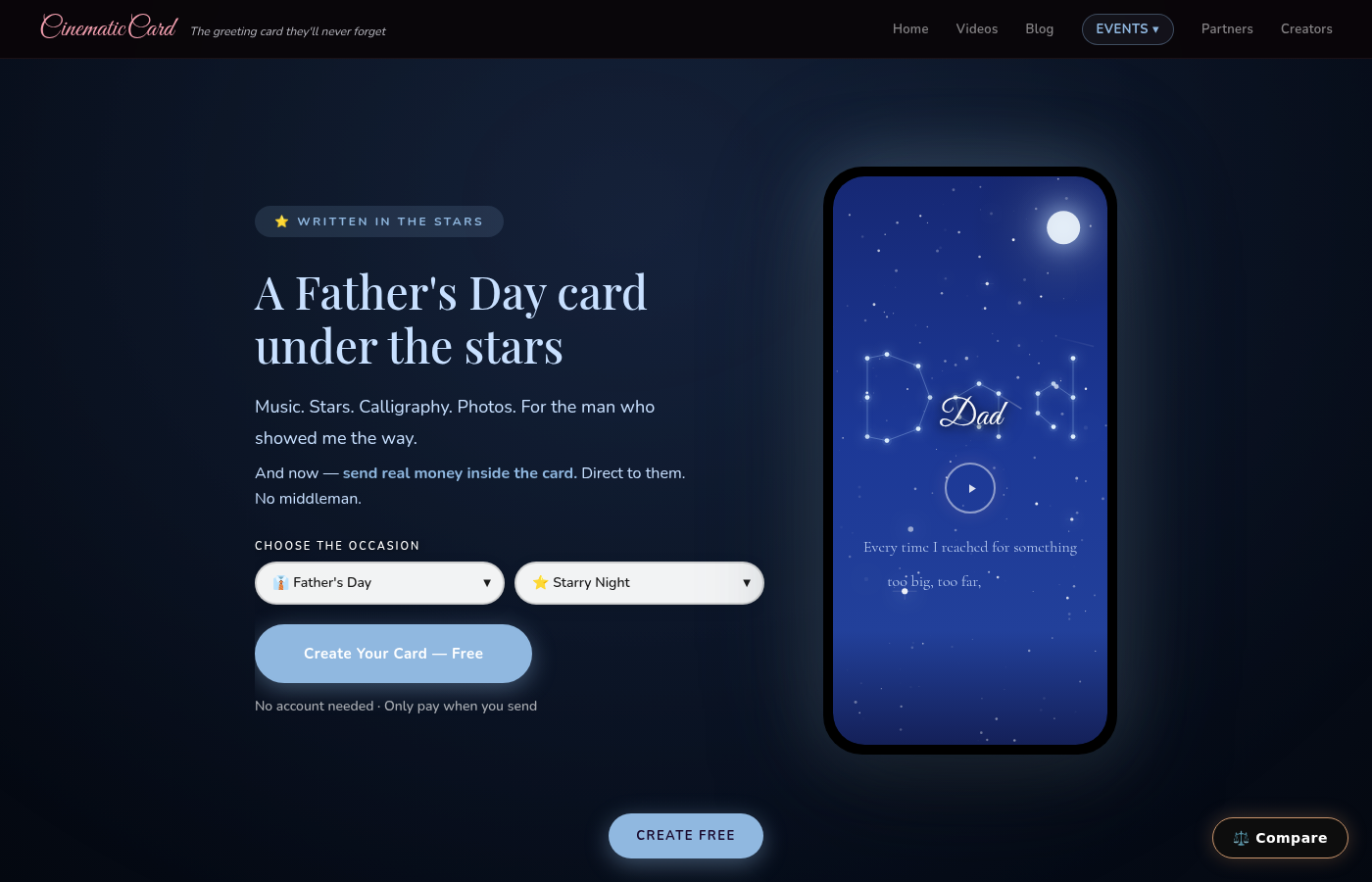
CinematicCard turns every greeting card into a cinematic experience. When someone opens their card, their name writes itself in beautiful calligraphy while music plays. Then the real show begins -- fireworks for birthdays, rose petals falling for anniversaries, or (this is my favorite) cigar smoke that secretly spells "DAD" drifting through a leather study for Father's Day.
But here's the part that can make someone want to watch it again: you can upload your own voice recording as the soundtrack. Imagine your mom opening her mother's day card and hearing your voice saying "Happy Mother's Day, Mom" while a butterfly dances through a garden scene and her photos play in a cinematic slideshow.
It's an easy feature to overlook.
Is a Digital Birthday Card Tacky?
This is the question everyone's thinking but nobody wants to ask. The answer depends entirely on execution.
A generic ecard with stock photos and preset text? Yeah, that can feel lazy. But a cinematic birthday card that includes their photos, your voice, and animations designed specifically for them? That's not tacky. That's thoughtful at scale.
The key is whether you're using technology to be more personal, not less. The best ecard alternatives give you tools to create something unique, not just fill in blanks on a template.
Beyond Static: What Real Animation Looks Like
Most "animated" ecards are just images with basic motion. A heart that pulses. Text that slides in from the left. Maybe some confetti that falls in a straight line.
Real animation tells a story. In CinematicCard's Valentine's theme for him, you're not just looking at a static fireplace -- the flames actually flicker with realistic light that illuminates the whole scene. There's wine on the table, subtle details in the shadows, and the entire experience feels like the opening scene of a romantic movie.
For kids' birthdays, instead of cartoon animals standing around, they actually dance while balloons rise and confetti bursts in every direction after a dramatic countdown. It's the difference between looking at a picture book and watching Pixar.
The Money Question: Cash Gifts in Digital Cards
Here's something most people don't expect from a digital card: real money inside it.
A CinematicCard Signature card ($9.99) lets you include an optional cash gift that gets revealed cinematically. They watch the full card, then see a glowing envelope animation with the gift amount. One tap takes them to Venmo, PayPal, or Cash App to claim it.
The money goes from you to them through the payment app you already use. CinematicCard just makes the moment they find it unforgettable.
How the Best Alternatives Compare
Against Hallmark ecards: Hallmark starts with one of its designs, which you personalize by uploading photos and adding a message. You sign in or join to send, and eCards come with free Crown Rewards (one free eCard a month) or unlimited with Hallmark+ ($8.99/month or $79.99/year). A CinematicCard starts the other way around: with up to 20 of your own photos, your music or voice, and your message, played as a cinematic slideshow — no account needed.

Against Moonpig and similar services: Moonpig is built around printed cards you personalize, with optional photo upload, mailed by post — plus eCards. It can add a QR code inside the card that links to a video or audio message. If you want paper in hand, that's a real strength; a CinematicCard is digital and can be shared the moment it's made.
Against JibJab and video cards: JibJab uses your photos to cut out faces and place them into its animated templates — great for a laugh. A CinematicCard uses your photos as the story itself, with your own music or an uploaded voice message.
The pattern here is clear, and it's why we argue static ecards are dead: too many cards are solving the wrong problem. They're making card-sending more efficient instead of making card-receiving more emotional.
Creating vs. Sending: The Free Preview Advantage
Here's a business model difference that matters: the best ecard alternatives let you create and preview your entire card for free. You only pay when you're ready to send it.
This means you can spend time getting it perfect. Upload photos, try different themes, upload your voice message, preview the whole experience -- all at no cost. You're only charged when you decide "yes, this is exactly what I want them to see."
With CinematicCard, previewing is always free, and your first card is free — the complete card, sent. After that, Classic is $3.99, Premium is $6.99 (your photos plus your own audio, like a voice message), and Signature is $9.99 if you're including a cash gift. No subscription, no account needed.
The Emotional Test
Here's how to judge any ecard alternative: would you want to receive this?
Not "would this be convenient to send" or "does this save me a trip to the store." Would you actually want this specific experience delivered to your phone?
Would you watch it more than once? Would you show it to someone else? Would you save it to look at later?
The best greeting cards -- physical or digital -- pass that test. They create a moment worth keeping.
What This Looks Like in Practice
Picture a mother turning 60 whose daughter lives across the country and can't make it home. Instead of a phone call, the daughter sends a CinematicCard with 15 years of photos, a recording of her own voice singing "Happy Birthday," and champagne glasses with golden bubbles rising while her mom's name writes itself in elegant script.
It's the kind of card a mom watches more than once, screenshots, and then calls her daughter about, moved.
That's not an ecard. That's a memory.
The Future Is Personal, Not Efficient
The greeting card industry spent the last decade making cards faster, cheaper, and more convenient. The best companies in 2026 are making them more personal, more emotional, and more memorable.
Technology should amplify human connection, not replace it. The right ecard alternative gives you tools to say "I love you" in ways that weren't possible before -- with your actual voice, with cinematic animation, with shared memories playing like a movie.
Want to see what this looks like? Create your first cinematic card free at CinematicCard.com. Pick any theme, upload your photos, upload a voice recording if you want. Preview the whole experience before you decide to send it.
Because the best greeting cards aren't the ones that are easiest to send. They're the ones that are impossible to forget.
Send Cash Inside Your Card
Include a real cash gift via Venmo, PayPal, or CashApp. Cinematic envelope reveal. One tap to claim.
How it works →Bulk Send: From $3.99/Card
Volume pricing: 25 @ $7.99, 100 @ $5.99, 500+ @ $3.99/card. Upload a CSV — each person gets their own personalized card.
See bulk pricing →Upload Your Own Audio
Upload a WAV, MP3 or MP4 — a song that means something, or a voice message you recorded on your phone.
Learn more →20 Photos. Your Whole Story.
Choose up to 20 moments from the photos on your phone and we turn them into a cinematic slideshow.
See it in action →Ready to make someone feel something real?
Your first CinematicCard is free. Previewing is always free.
Create Your Card Free